Why is Christmas celebrated on December 25th? Was Yeshua born on this day? What does a decorated tree, gift giving, a fat man in a suit and elf on the shelf have to do with the Son of God and his birth?
Christ Mass
The Blasphemy of Christ ( MASS )
Most people think that the word, “Christmas” means “the birth of Christ.”
The word Christmas comes from “Cristes Maesse”, an early English phrase that means
“Mass of Christ.”
The phrase is a combination of the Greek word Christos, which means “anointed one” or “Messiah,” and the Latin word missa, which means “mass”.
Page 537 of the Catholic Encyclopedia, says:
“In the Christian law, the supreme sacrifice is that of the Mass.”
The word “Mass” in religious usage means a “death sacrifice.”
When millions of people are saying, “Merry Christmas”, they are literally saying: “
Merry death of Christ!”
The word “Merry” is simple to define. It unquestionably means to be happy, joyful and light-hearted. The word “merry” fits into the ambience of laughter. This word “merry” by itself is innocent enough, but as we will now see, it becomes heinously blasphemous when used with the word “Christmas.”
The word “Mass” as used by the Roman Catholics, has traditionally been rejected by the so-called Protestants, such as Lutherans, Baptists, Methodists, Presbyterians, Pentecostals and so on. The word “Mass” is strictly a Catholic word and thus, so is “Christ-Mass.”
It would stand to reason, that since all of these denominations love and embrace “Christ-Mass”, that December 25th is the great homecoming day, when all of the Protestants become Catholic for a day. It would seem that all of the so-called “many harlots” of the Roman Catholic Church return to their mother, the Whore of Babylon.
When the fat man in the red suit laughs boisterously and says,
“Ho ho ho, Merry Christmas”, he is mocking and laughing at the suffering and bleeding Savior, the Son of God.
Ho Ho Ho
This term came from the mid 16th century during plays just before the devil character would come on stage he would announce himself by saying Ho Ho Ho!
Old Nick
“Old Nick” is a colloquial or informal term used to refer to the Devil or Satan in the English language, and it is indeed recognized in dictionaries like the Oxford English Dictionary.
His elves were called Krampus demons.
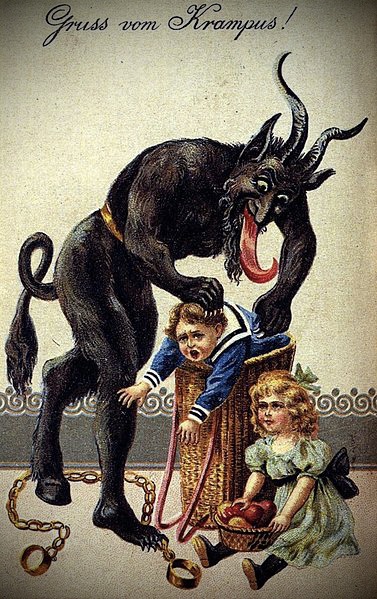
Krampus is a half-goat, half-demon figure from Central European folklore who punishes children who misbehave at Christmas time.
Origins
“Christmas” was originally a heathen festival celebrated on the 25th of December in honour of the birth of Tammuz ( Ezek. 8:14 ), also called Baal the Sun-god, the son of Semiramis, the Babylonian Queen of heaven. The celebrations included hymn-singing in the street, riotous merry-making, feasting, drunkenness and the giving of gifts. Among the Romans these pagan ceremonies, known as Saturnalia, were held in honour of the victory of Sol Invictus ( the unconquerable Sun-god ), over the darkness at the winter solstice. The Sun-god in the Saturnalia ceremonies was likened to a small child. . . This pagan festival was taken over by the Church of Rome in the fourth century to commemorate the birth of Christ. The name “Christmas” is a combination of the name of Christ and the word “mass” – the Roman Catholic mass.
The entire tradition has its roots in the paganism of ancient Babylon, which goes back to Nimrod and his wife, Semiramis. After Nimrod’s untimely death, his consort claimed a full-grown evergreen tree sprang up overnight from a dead tree stump, which symbolized the springing forth unto new life of the dead Nimrod. Their son Tammuz was born. Said to be the reincarnate of Nimrod, also known as Baal, Bel, Belial, Marduk, Moloch, etc…
The Persian Mithra was believed to be the god of light, oath, and truth, seen as the divine embodiment of contracts. He was also believed to be the guardian of cattle and of the waters. The Roman Mithras was associated with Sol Invictus, the Roman god of the sun.
If Christmas was actually a holiday from the Bible, it would not be celebrated by Atheists, New Agers, Wiccans, Pagans and pretty much the entire world…
– – – – – – – – – – – – – – – – – – – – – – –
Matthew 15:8–9
“This people draweth nigh unto me with their mouth, and honoureth me with their lips; But their heart is far from me. But in VAIN they do worship me, Teaching for DOCTRINES the commandments of men.”
– – – – – – – – – – – – – – – – – – – – – – –
Nowhere in the Bible or any writings from the early church for the first 300 years ever declared Dec 25th as the birthday of Yeshua.
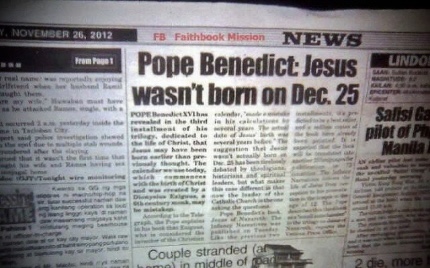
November 25th, 2012
The Roman Catholic Church started celebrating the birth of Christ / Christmas on Dec 25th in 336 AD.
Shepherds in the Field
History convincingly shows that December 25 was popularized as the date for Christmas, not because Yeshua was born on that day but because it was already popular in pagan religious celebrations as the birthday of the sun.
A careful analysis of Scripture, however, clearly indicates that December 25 is definitely not the day of his birth.
Here are two primary reasons:
We know that shepherds were in the fields watching their flocks at the time of Yeshua’ birth.
Weather
The month of Chislev, which corresponds to November and December, was known for being cold and rainy. The Bible describes shepherds tending their flocks on the night of Yeshua’ birth, which would have been difficult in the cold and rain.
Luke 2:7–8
“And she brought forth her firstborn son, and wrapped him in swaddling clothes, and laid him in a manger; because there was no room for them in the inn. And there were in the same country shepherds abiding in the field, keeping watch over their flock by night.”
Shepherds were not in the fields during December. According to Luke’s account suggests that Yeshua may have been born in summer or fall. Since December is cold and rainy in Judea, it is likely the shepherds would have sought shelter for their flocks at night.
Roman Census
Yeshua’ parents came to Bethlehem to register in a Roman census.
Roman census were not taken in the winter, when roads were poor and temperatures were often below freezing.
Luke 2:1–4
“And it came to pass in those days, that there went out a decree from Cæsar Augustus, that all the world should be taxed. ( And this taxing was first made when Cyrenius was governor of Syria. ) And all went to be taxed, every one into his own city. And Joseph also went up from Galilee, out of the city of Nazareth, into Judæa, unto the city of David, which is called Bethlehem; ( because he was of the house and lineage of David )”
William Walsh, The Story of Santa Klaus, 1970, p. 62
“Such censuses were not taken in winter, when temperatures often dropped below freezing and roads were in poor condition. Taking a census under such conditions would have been self-defeating.
Given the difficulties and the desire to bring pagans into Christianity, “the important fact then . . . to get clearly into your head is that the fixing of the date as December 25th was a compromise with paganism”.
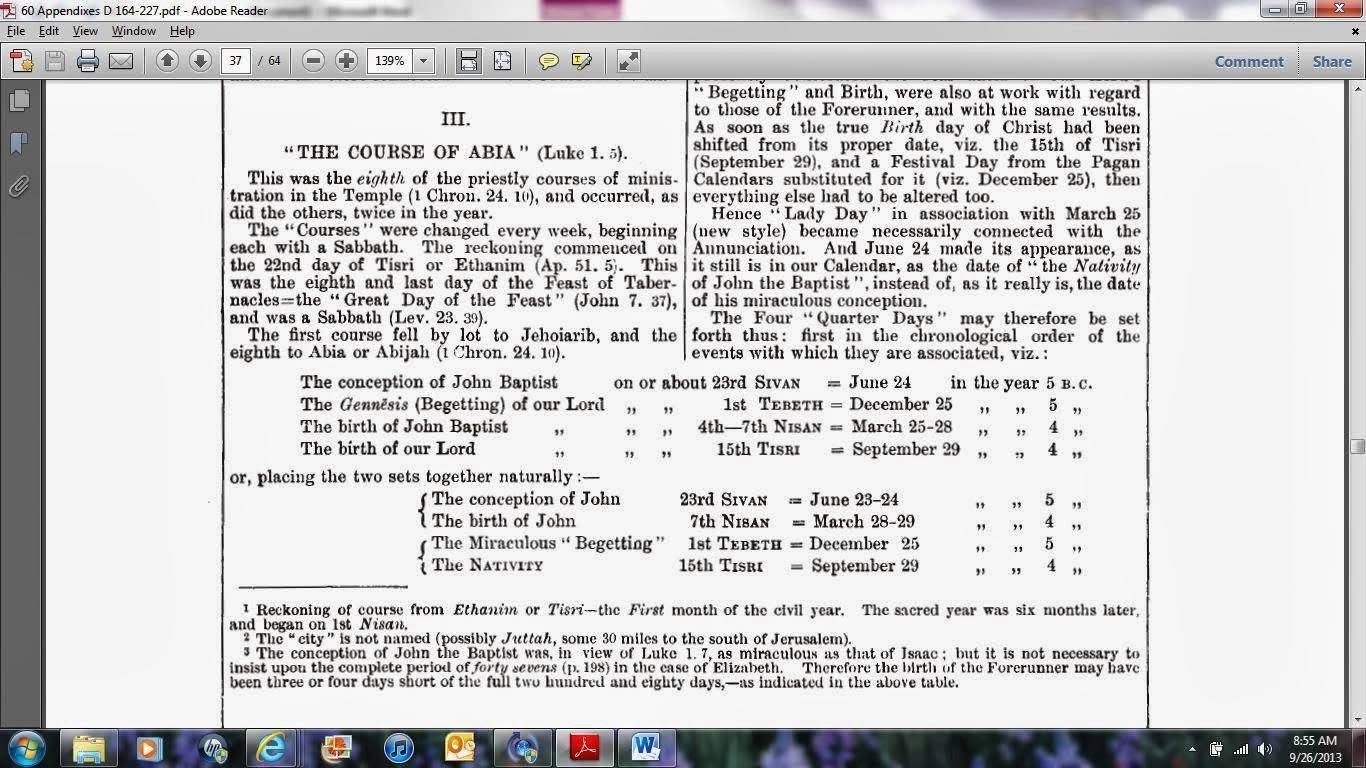
The Companion Bible, 1974, Appendix 179, p. 200
Since Elizabeth ( John’s mother) was in her sixth month of pregnancy when Yeshua was conceived ( Luke 1:24-36 ), we can determine the approximate time of year Yeshua was born if we know when John was born. John’s father, Zacharias, was a priest serving in the Jerusalem temple during the course of Abijah.
Luke 1:5
“There was in the days of Herod, the king of Judæa, a certain priest named Zacharias, of the course of ABIJAH: and his wife was of the daughters of Aaron, and her name was Elisabeth.”
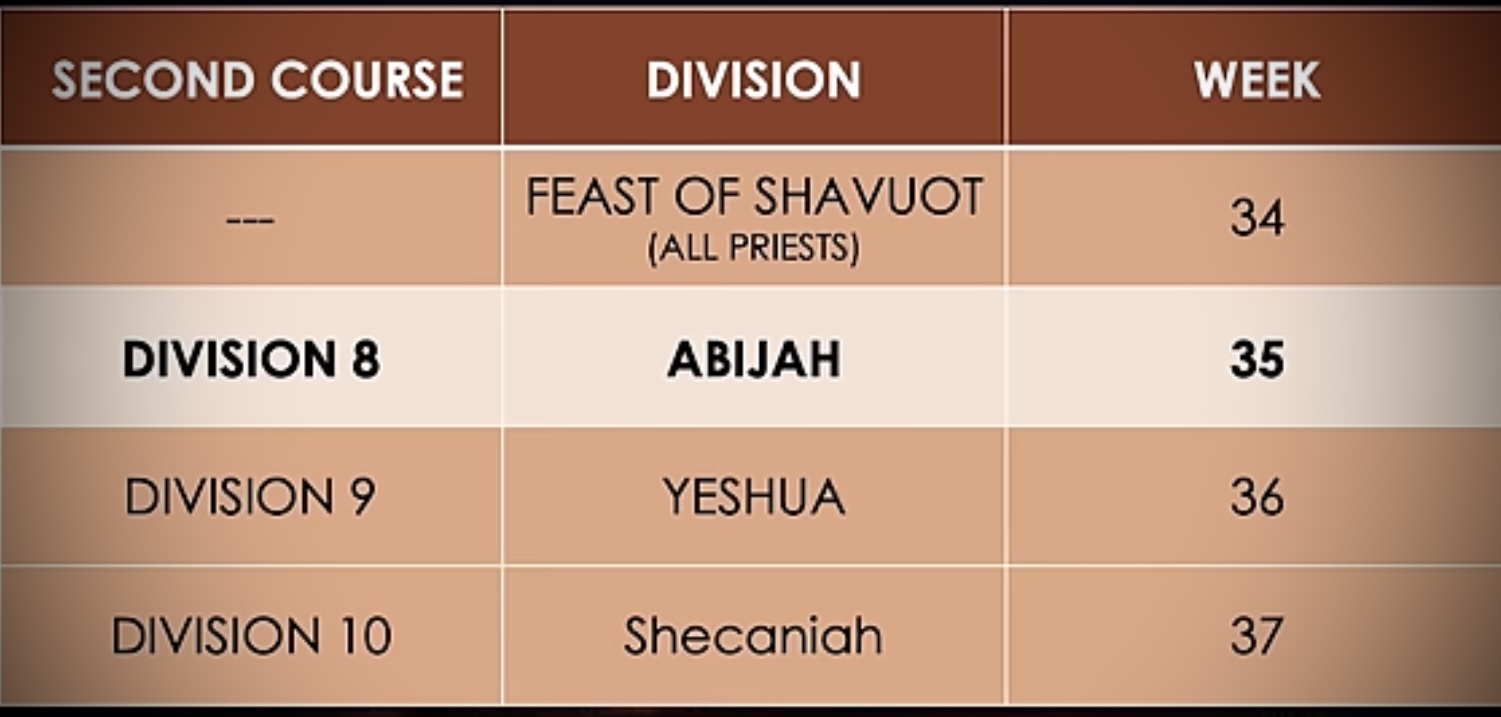
He was in the priestly order of Abijah. This was the 8th of 24 priestly orders. Abijah would served twice a year, once in the first half of the year and once in the second half. During the three mandatory pilgrimages to Jerusalem all the priests would minister on those three days.
1 Chronicles 24:1, 7-10
” Now these are the divisions of the sons of Aaron. The sons of Aaron were Nadab, Abihu, Eleazar, and Ithamar.
Now the first lot fell to Jehoiarib, the second to Jedaiah, the third to Harim, the fourth to Seorim, the fifth to Malchijah, the sixth to Mijamin, the seventh to Hakkoz, the eighth to ABIJAH…
Historical calculations indicate this course of service corresponded to June 13-19 in that year.
Levitical Priestly System
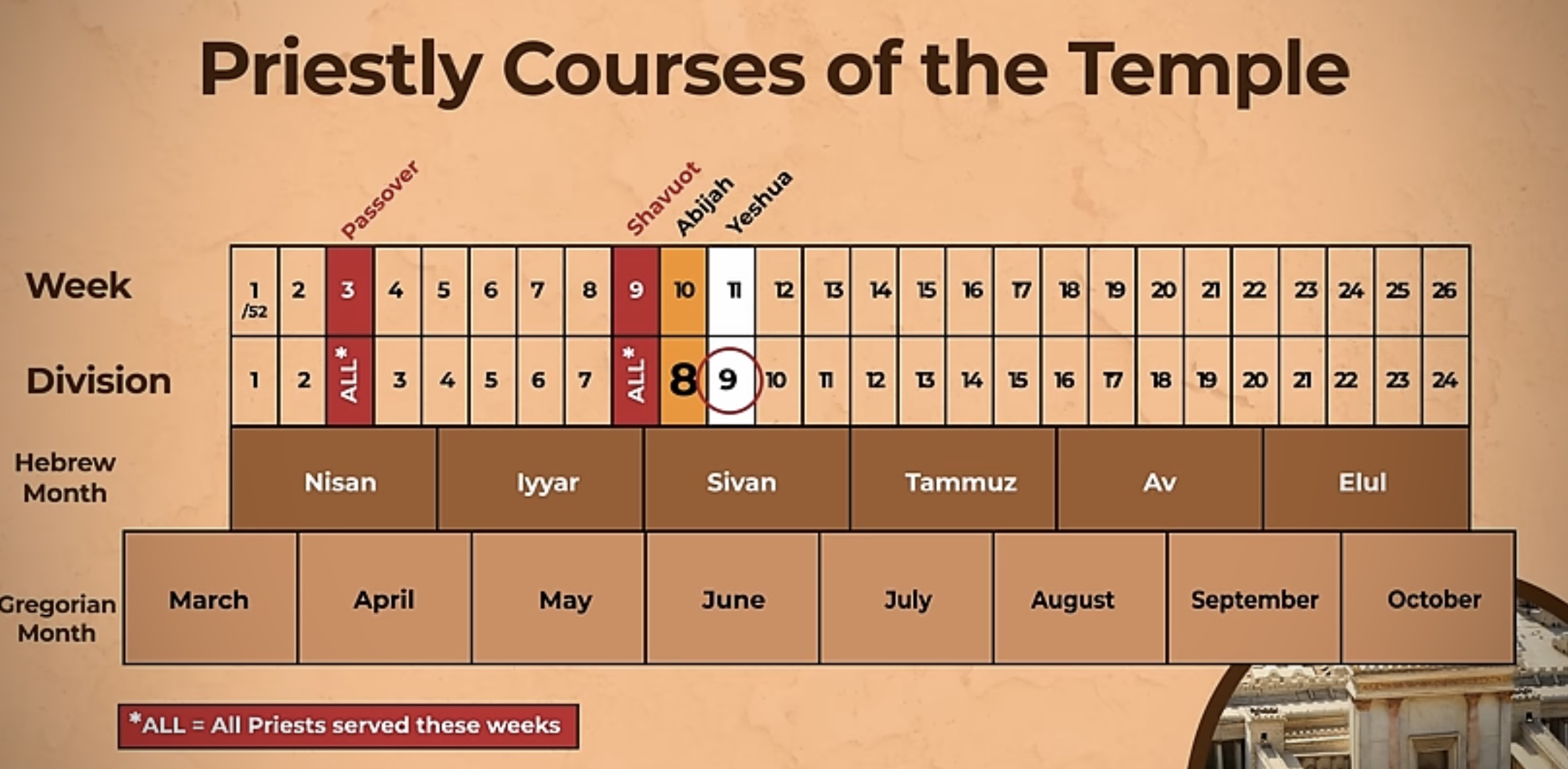
The eighth division corresponds to the 10th week of the year.
Luke 1:23–24
“And it came to pass, that, as soon as the days of his ministration were accomplished, he departed to his own house. And after those days his wife Elisabeth conceived, and hid herself five months”
So Elizabeth conceived John in the ninth ministration called Yeshua.
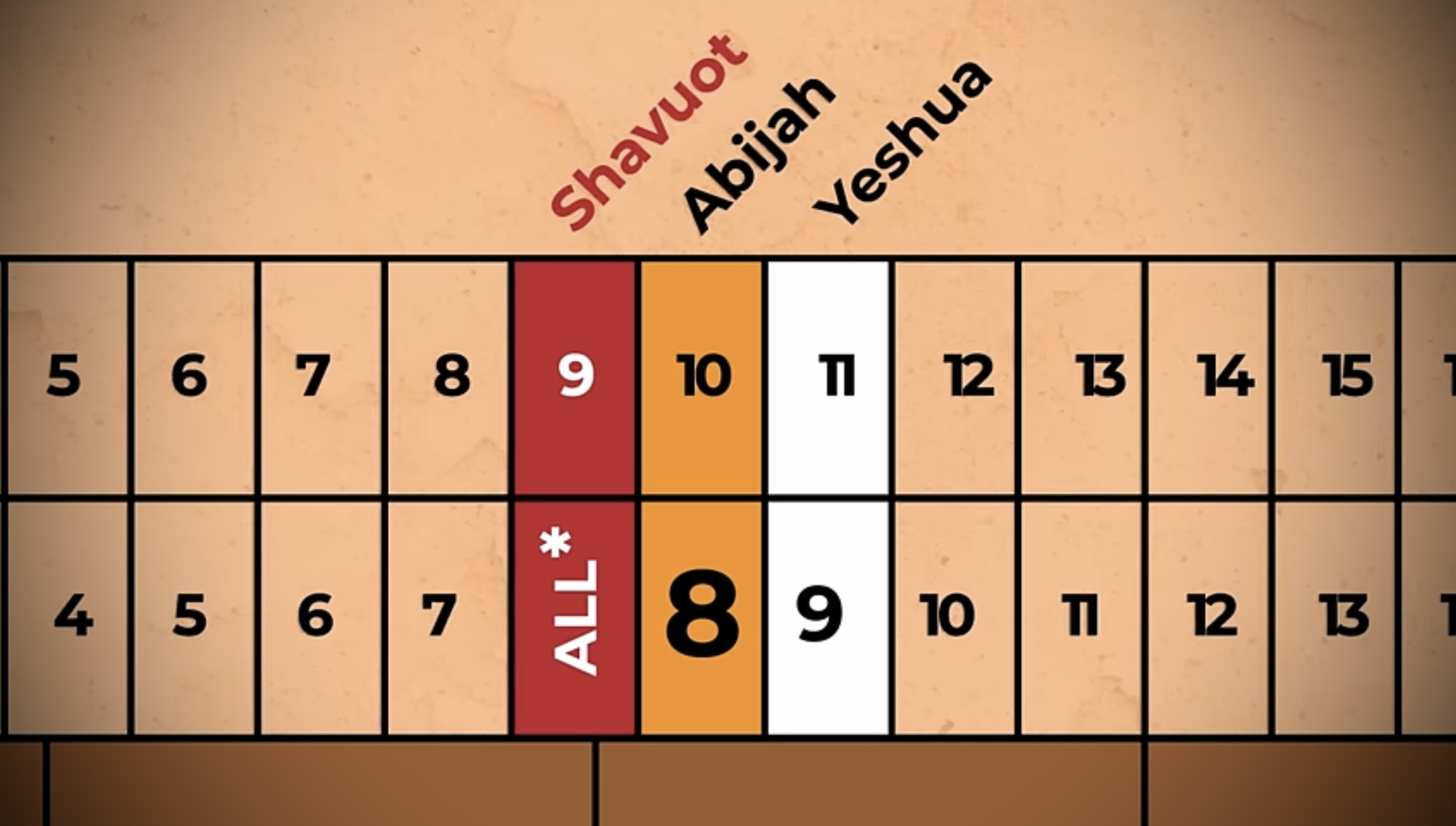
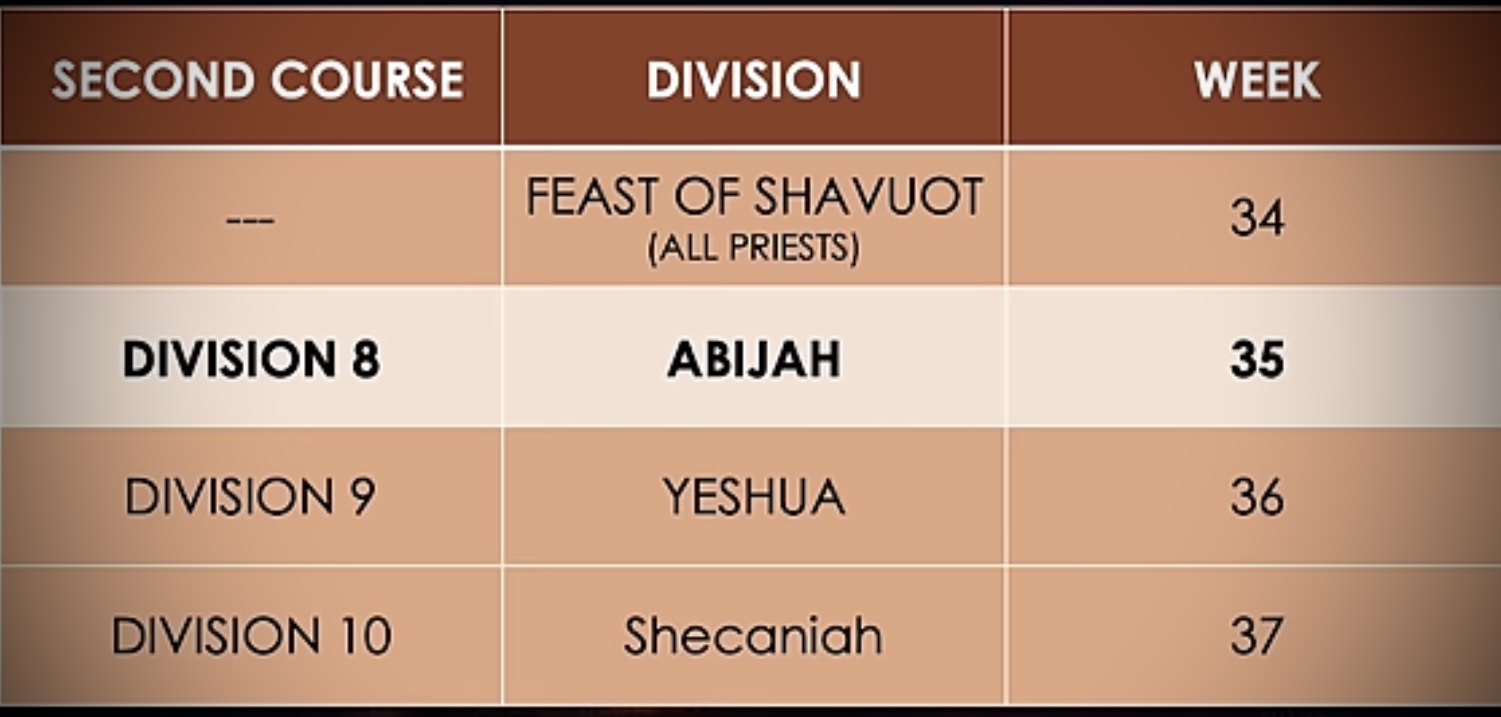
John The Baptist is conceived during the 9th division which is called Yeshua
Yeshua is conceived during the same divison, 6 months later
Both John and Yeshua conceived during the division of YESHUA
9 MONTHS LATER FROM JUNE
6 MONTHS AFTER PASSOVER IS…
Sukkot!
( The Feast of Tabernacles )
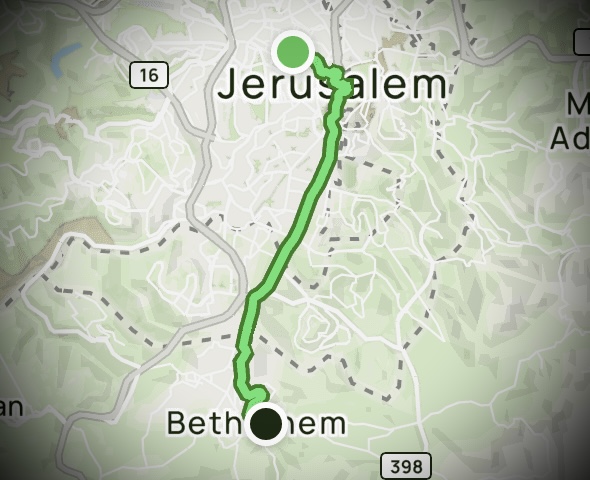
Bethlehem means House of Bread
Conclusion for option 1
It was during this time of temple service that Zacharias learned that he and his wife Elizabeth would have a child ( Luke 1:8-13 ). After he completed his service and traveled home, Elizabeth conceived ( Luke 1:23-24 ).
Yeshua’s conception took place near the end of June, adding nine months brings us to the end of March as the most likely time for John’s birth. Adding another six months ( the difference in ages between John and Yeshua ) brings us to the end of September or
beginning of October as the likely time of Yeshua’ birth.
Option 2
If Zachariah was ministering during the second course of his temple service, when the angel Gabriel spoke to him, then John, the Baptist would be the one that was born during tabernacles and Yeshua was born during Passover.
– – – – – – – – – – – – – – – – – – – – – – –
Matthew 3:1–3
“In those days came John the Baptist, preaching in the wilderness of Judæa, and saying, Repent ye: for the kingdom of heaven is at hand. For this is he that was spoken of by the prophet Esaias, saying, The voice of one crying in the wilderness, Prepare ye the way of the Lord, Make his paths straight.”
Winter Solstice
The winter solstice is the reversal of the Sun’s apparent ebbing in the sky; the daytime stops becoming shorter and begins to lengthen again.
In parts of ancient Europe, this was symbolized as the death and rebirth of the Sun, or of a Sun god.
Winter solstice on the Gregorian calendar is the 21st but the calendar prior which is the Julian calendar. It landed on 25 December. Gregorian calendar came into affect in 1582 AD. Julian calendar was created in 46 BC. The calendar changed, but the date stayed the same. Celebrating the pagan worship of the sun god.
_________________________________
Plutarch, On Isis and Osiris, 1st Century AD
“For this reason it is said that Isis, when she was aware of her being pregnant, put on a protective amulet on the sixth day of Phaophi, and at the winter solstice gave birth to Harpocrates.”
( Harpocrates was the sun god Horus as a child, Plutarch is saying Horus was born on a winter solstice )
_________________________________
Epiphanius
The Panarion of Epiphanius of Salamis, Books II & III.
De Fide 51.22.9-11
22.9 “First, at Alexandria, in the Coreum, as they call it; it is a very large temple, the shrine of Core. They stay up all night singing hymns to the idol with a flute accompaniment. … 22.10 And when you ask them what this mystery means they reply that today at this hour Core that is, the virgin gave birth to Aeon.”
Epiphanius
The Panarion of Epiphanius of Salamis, Books II & III.
De Fide 51.22.3
Greeks, I mean the idolaters, celebrate this day on the eighth before the Kalends of January ( December 25 ), which Romans call Saturnalia, Egyptians Cronia, and Alexandrians, Cicellia.
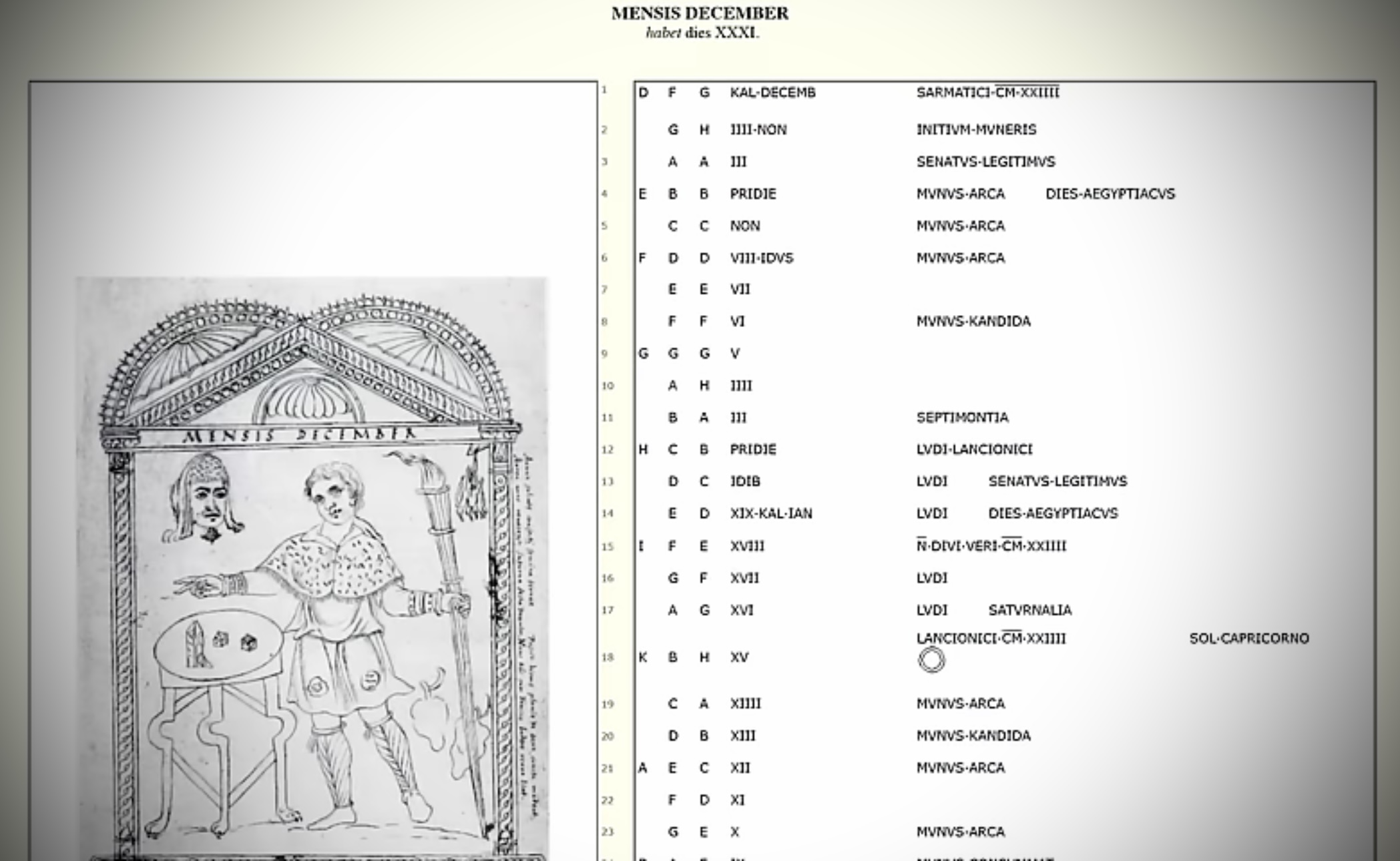
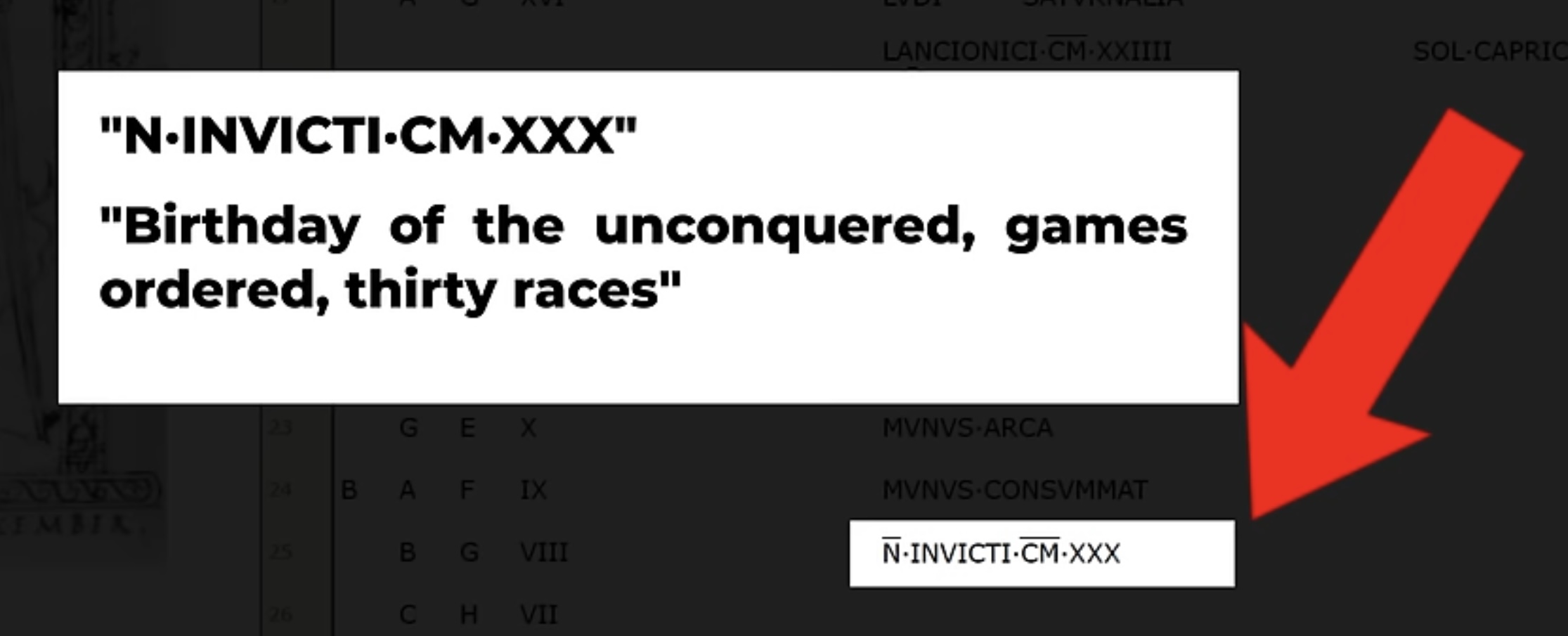
Oldest writing of Pagan feast to Sol Invictus December 25th, it list this day as a Pagan holiday
Roman Calendar from 354 AD created by Philo Callus
_________________________________
Bishop Martin of Braga, 575 AD
Acta Conciliarum
V.ili.399, quoted in Tille (1899), p. 103 n.2)
“You shall not perform the wicked celebration of the calends and observe the holiday of the gentiles, nor shall you decorate your houses with laurel and green branches. This whole celebration is pagan.”
_________________________________
Winter solstice celebration of the sun god was celebrated in Rome, Greece, Egypt, Aztecs, China, Japan, etc…
All across the world…
– – – – – – – – – – – – – – – – – –
Idolatree



Deuteronomy 5:8–10
“Thou shalt not make thee any graven image, or any likeness of any thing that is in heaven above, or that is in the earth beneath, or that is in the waters beneath the earth: thou shalt not bow down thyself unto them, nor serve them: for I the LORD thy God am a jealous God, visiting the iniquity of the fathers upon the children unto the third and fourth generation of them that hate me, and shewing mercy unto thousands of them that love me and keep my commandments.”
The Second Commandments covers Idolatry. The last commandment covers covetousness.
Christmas is the time of year when ALL faiths put away their beliefs to celebrate Paganism.
This practice is not Biblical but is in the Bible…
For the people who say that the Christmas tree does not fall up under the condemnation of Jeremiah 10. Let’s analyze the verses to find out.
Verse 2 speaks of the heathen being dismayed at the signs in the heavens. This is exactly what ancient heathen peoples did during the winter solstice time. They were dismayed at a fact within nature whereby Yah caused the sun to rule the day for a shorter period of time than any other day of the year. The heathens would bring into their homes pieces of nature ( specifically evergreen trees ) which symbolized life to them, in hopes of appeasing the
S-U-N deity to come back and bring them longer days
Verse 3 mentions cutting a tree out of the forest. That is not difficult to understand, and that is exactly what people do for Christmas.
Verse 3 mentions the work of the hands of the workman with the axe.
Some people point to this and say that it is speaking of some type of chiseling down the wood into a form. I know for certain that “Asherah trees” were sometimes planted and that they didn’t take on a specific idol image, but were just a representation of what the goddess Asherah stood for – fertility.
The phrase about the workman with the axe seems most likely to me to describe the man who cut down the tree out of the forest with the axe, and not to chiseling it into some type of image.
Verse 4 mentions decking it with silver and gold which is just another way of saying “they decorate the tree.”
Verse 4 also mentions fastening it with nails and hammers so it doesn’t move. This makes more sense to me to be speaking of a tree that has simply been cut down. A tree would need to be fastened so as not to topple. An image-idol could be carved in such a way as to stand up alone with no need of fastening it down to not move.
Fact of the matter is that that the heathens worshiped trees as idols! The modern day Christmas tree finds its origins in winter solstice celebrations of the heathen nations, thus the Christmas tree falls under the condemnation of Jeremiah 10, and all tree worship by heathens stems from ancient Asherah worship.
Jeremiah 10:2–5
“Thus saith the LORD, Learn not the way of the heathen, and be not dismayed at the signs of heaven; for the heathen are dismayed at them. For the customs of the people are vain: for one cutteth a tree out of the forest, the work of the hands of the workman, with the axe. They deck it with silver and with gold; they fasten it with nails and with hammers, that it move not. They are upright as the palm tree, but speak not: they must needs be borne, because they cannot go. Be not afraid of them; for they cannot do evil, neither also is it in them to do good.”
Deuteronomy 12:30–32
“take heed to thyself that thou be not snared by following them, after that they be destroyed from before thee; and that thou enquire NOT after their gods, saying, How did these nations serve their gods? even so will I do likewise. Thou shalt not do so unto the LORD thy God: for every abomination to the LORD, which he hateth, have they done unto their gods; for even their sons and their daughters they have burnt in the fire to their gods. What thing soever I command you, observe to do it: thou shalt not add thereto, nor diminish from it.”
Your Christmas Tree is Idolatry
Psalm 135:15–18
“The idols of the heathen are silver and gold, the work of men’s hands. They have mouths, but they speak not; Eyes have they, but they see not; They have ears, but they hear not; Neither is there any breath in their mouths. They that make them are like unto them: So is every one that trusteth in them.”
2 Corinthians4:3–4
“But if our gospel be hid, it is hid to them that are lost: in whom the god of this world hath blinded the minds of them which believe not, lest the light of the glorious gospel of Christ, who is the image of God, should shine unto them.”
Jeremiah 7:10
“and come and stand before me in this house, which is called by my name, and say, We are delivered to do all these abominations?”
History of the Christmas Tree
The tradition of decorating a tree with lights and ornaments comes from Germanic tribes and Roman customs celebrating the winter solstice. Pagans would put tree branches around their homes to symbolize the coming of spring.
Ancient Rome
Ancient Romans decorated their o homes with evergreen boughs during Saturnalia, a feast centering on the winter solstice
1500s
Germans begin the tradition of bringing decorated trees into their homes for Christmas • Martin Luther is the first person to add candles to the tree
1600s
In England, Oliver Cromwell preached against “the heathen traditions” of Christmas carols and decorated trees
1830s
German settlers in Pennsylvania set up the first recorded publicly displayed Christmas tree in the U.S. Christmas was banned in America until this time because of its Pagan roots.
1846
A sketch is published of Oueen
Victoria and her family standing • around a Christmas tree • Christmas trees become fashionable in Britain and the U.S.
1882
Edward Johnson put together the first string of electric lights for a Christmas tree
1923
President Coolidge lights the first National Christmas Tree in Washington, D.C.
1931
The first Christmas tree is placed outside of Rockefeller Center in New York City by construction workers for their construction site
Yule
Yule is a winter solstice festival with ancient Pagan origins that is celebrated by many Pagans and Wiccans in the Northern Hemisphere on December 21.
Yule, the longest night of the year. In pagan traditions around the northern hemisphere, witches, druids, and Wiccans celebrate the sun’s rebirth.
Huge Yule logs were burned in honor of the Sun god (Baal).
Kissing under the mistletoe began as a fertility rite and fornicating parties
The ancient Druids held their religious ceremonies around a cut evergreen tree, while others would bring it into their home and place 12 candles on the tree representing the 12 days of Yule.
Origins of the Druids
The earliest known records of the Druids come from the 3rd century BCE. Their name may have come from a Celtic word meaning “knower of the oak tree”.
Norse origins
The festival is generally thought to have originated as a Norse festival called jol. Vikings celebrated Yule with feasts, toasts, and boasting, especially to Odin, who was associated with the festival. The Yule log tradition originated in the Nordic lands and symbolizes warmth and light during the winter.
In Norse mythology, Odin, the chief god of the Aesir, is depicted as one-eyed because he sacrificed his right eye to gain divine wisdom
Most scholars believe the attributes of Santa Clause come from Odin, in Norse mythology.
Pagans are the Reason for the Season!
Scholars have connected the original celebrations of Yule to the Wild Hunt. Just as Nimrod was considered the hunter of men.
Genesis 10:8–9
“And Cush begat Nimrod: he began to be a mighty one in the earth. He was a mighty hunter before the LORD: wherefore it is said, Even as Nimrod the MIGHTY HUNTER before the LORD.”
Scholars have connected the original celebrations of Yule to the Wild Hunt, the god Odin, and the heathen Anglo-Saxon Mōdraniht (“Mothers’ Night”). Connection to the spirits of the dead in Norse culture, Yule was believed to be the time when the spirits of the dead were passed on to the Otherworld. These spirits were honored and celebrated during Yule, and animals were sacrificed in their honor. Yule is a celebration of light, fire, and feasting. Some modern Christmas customs and traditions, such as the Yule log, Yule goat, and Yule singing, may have connections to older pagan Yule traditions.
– – – – – – – – – – – – – – – – – –
2 Corinthians 11:14
“And no marvel; for Satan himself is transformed into an angel of light.”
Ezekiel 8:17
“Then he said unto me, Hast thou seen this, O son of man? Is it a light thing to the house of Judah that they commit the abominations which they commit here? for they have filled the land with violence, and have returned to provoke me to anger: and, lo, they put the branch to their NOSE.”
Isaiah 5:20
“Woe unto them that call evil good, and good evil; that put darkness for light, and light for darkness; that put bitter for sweet, and sweet for bitter!”
Unsettling History
Leviticus 18:21
“And thou shalt not let any of thy seed pass through the fire to Molech, neither shalt thou profane the name of thy God: I am the LORD.”
In ancient Moab, there was a public child mass celebration during the winter around December 25th, in the form of a public ritual sacrifice. Parents would make a list of things they wanted to happen the next year, and then they would sacrifice their children, who were born that year, to their god, Molech, in the hope that their prayers would be answered.
During the ritual sacrifice, the priest of chemosh would build big fires inside the hollow metal idol of the god, chemosh.
Then, the priest would collect the children from their parents and place them on the lap of the hot metal idol Chemosh as a form of sacrifice.
Jeremiah 32:35
“And they built the high places of Baal, which are in the valley of the son of Hinnom, to cause their sons and their daughters to pass through the fire unto Molech; which I commanded them not, neither came it into my mind, that they should do this abomination, to cause Judah to sin.”
Since that metal would be hot as a furnace, the children would then burn with their voices screaming to the heavens. The idol god Molech also wore a hat that is similar to what Santa wears, and one that the pagan god of the sun, Mithra, wore.
Pay close attention to the images of both hats because they were worn by both pagan gods and are similar to what Santa Claus wears today.
Today, that aspect of child ritual sacrifice may have changed, but there is still a similarity. During the Christmas season, people all over the world continue to take their children to sit on the lap of Santa Claus, who is similar to various pagan deities.
Red attire has been prevalent for thousands of years, and it is not a recent development in our generation. The wearing of red clothing is an ancient ritual rite that has its roots deep-rooted in paganism. Before the Moabites would offer their children for sacrifice, they would wear red clothes to signify the beginning of a blood sacrifice of a loved one.
The book of Isaiah gives us a glimpse into the origins of red attire and how it’s connected to Pagan worship.
Over time, some cultures stopped using the name Sinterklaas entirely and kept only Weihnachtsmann, which means Santa Claus in Germanic languages.
Krampusnacht
In Alpine Austria and some parts of Germany, Krampusnacht, or “Krampus night,” was a day when adults would dress up as Krampus to frighten children in their homes.
– – – – – – – – – – – – – – – – – – – – – – – –
Christmas was established to enable Pagan converts to come into the church with out forsaking their heathen customs and practices which was Paganism.
– – – – – – – – – – – – – – – – – – – – – – – –
Baal and Asherah Poles connected
Judges 6:25–26
“And it came to pass the same night, that the LORD said unto him, Take thy father’s young bullock, even the second bullock of seven years old, and throw down the altar of Baal that thy father hath, and cut down the grove that is by it: and build an altar unto the LORD thy God upon the top of this rock, in the ordered place, and take the second bullock, and offer a burnt sacrifice with the wood of the grove which thou shalt cut down.”
– – – – – – – – – – – – – – – – – –
Pontius Maxima, Discovered in St Michael’s, Farnborough in 1916 in the municipal library at Troyes
“They also call it ‘Birthday of the Invictus’ [unconquered]. But who is Invictus if not our Lord, who suffered death and then conquered it? Or when they call it ‘Birthday of the Sun’ – well, Christ is the sun ( servant ) of righteousness that the prophet Malachi spoke of: The sun of righteousness shall arise for all you who fear his name; salvation is in his wings.”
– – – – – – – – – – – – – – – – – – – – – – – –
The worship of the sun god, especially on December 25 was not just practiced in Rome, but also all around the world, all paying homage to the sun god worshiped in that region.
– – – – – – – – – – – – – – – – – – – – – – – –
St. Augustine of Hippo
The works of Saint Augustine, A translation for the 21st Century Part III Sermons Volume 6: Sermon 190
“And so, my brethren, let us hold this day as sacred, not as unbelievers do because of the material sun, but because of Him who made the sun.”… “Now, though, he is also over that sun even in the flesh, the sun which people worship instead of God, because in their mental blindness they cannot see the true sun of justice”
According to Augustine the day that the Pagans worshipped the Sun, was the same day they were celebrating the birthday of Yeshua.
Steven Himans
“Sol Invictus, the winter solstice, and the origins of Christmas,” in: Mouseion III.3 (2003), 378
The De Pascha Computus, which was written in 243 A.D. to determine the date of Easter, argued “that Christ, the new ‘Sun of Righteousness,’ must have been born on March 28th.”
This means mid third century the date for Yeshua’s birth was still not known.
Emperor Julian, The Apostate
Hymn to King Helios, 361 AD
“Before the beginning of the year, at the end of the month which is called after Kronos, we celebrate in honour of Helios [the Greek sun god] the most splendid games, and we dedicate the festival to the Invincible Sun.”
Arendzen J. Mithraism. The Catholic Encyclopedia, Volume X. Nihil Obstat, October 1, 1911.
John Cardinal Farley, Archbishop of New York:
Robert Appleton Company, 1911).
“Helios Mithras is one god…Sunday was kept holy in honour of Mithra, …The 25 December was observed as his birthday, the natalis invicti, the rebirth of the winter-sun, unconquered by the rigours of the season”
– – – – – – – – – – – – – – – – – –
THE IDOLATRY OF SELF ESTEEM THE HIGHEST OF SATAN’S HOLY DAYS / HOLIDAYS
– – – – – – – – – – – – – – – – –
– – – – – – – – – – – – – – – – – – – – – – –
Quote from churchofSatan.com
The Christians stole this holiday from the pagans Santa Claus has come to signify indulgence, and he is a combination of Dionysos and Silenus from Roman and Greek myths (the Romans celebrated the orgiastic Saturnalia at this time).
The Nazarene has little place in the general public’s celebrations of this season, which were meant by pagans to be celebrations of abundance during a season of cold and emptiness.
So for the Yule holiday season we enjoy the richness of life and the company of people whom we cherish, as we will often be the only ones who know where the traditions really came from!
There is an affinity of such commemoration among the wicked as recorded in The Satanic Bible ( Anton LaVey, (Air) Book of Lucifer – The Enlightenment, Avon Books, 1969, Ch XI, Religious Holidays, p. 96 ) regarding Birthdays:
“The highest of all holidays in the Satanic religion is the date of one’s own birthday. This is in direct contradiction to the holy of holy days of other religions, which deify a particular god who has been created in an anthropomorphic form of their own image, thereby showing that the ego is not really buried. The Satanist feels: ‘Why not really be honest and if you are going to create a god in your image, why not create that god as yourself.” Every man is a god if he chooses to recognize himself as one. So, the Satanist celebrates his own birthday as the most important holiday of the year. After all, aren’t you happier about the fact that you were born than you are about the birth of someone you have never even met? Or for that matter, aside from religious holidays, why pay higher tribute to the birthday of a president or to a date in history than we do to the day we were brought into this greatest of all worlds?
Despite the fact that some of us may not have been wanted, or at least were not particularly planned, we’re glad, even if no one else is, that we’re here! You should give yourself a pat on the back, buy yourself whatever you want, treat yourself like the king (or god) that you are, and generally celebrate your birthday with as much pomp and ceremony as possible.”
It is interesting that birthdays are considered the most important holiday to these Satan worshipers ( the founding of their “church”, called Walpurgisnacht, and Halloween are the other ones of importance to them
Origen of Alexandria, writing over two centuries after the death of Yeshua follows this same line when he recorded a diatribe against the memories of birthdays, indicating that at the time of his writing, a day to remember the birth of Yeshua was not part of the church calendar. In his Homilies on Leviticus, speaking on the aspect of birth, Origen states:
..not one from all the saints is found to have celebrated a festive day or a great feast on the day of his birth. No one is found to have had joy on the day of the birth of his son or daughter. Only sinners rejoice over this kind of birthday. For indeed we find in the Old Testament Pharaoh, king of Egypt, celebrating the day of his birth with a festival, and in the New Testament, Herod. However both of them stained the festival of his birth by shedding human blood. . . . But the saints not only do not celebrate a festival on their birth days, but, filled with the Holy Spirit, they curse that day (, after the example of Job, Jeremiah and David.
Barkley, Homilies on Leviticus: 1-16 / Origen, 156.
– – – – – – – – – – – – – – – – – – – – – – – –
What is the origin of birthday celebrations?
Birthday celebrations are actually rooted in paganism.
_________________________________
Encyclopedia Americana (1991) states:
“The ancient world of Egypt, Greece, Rome, and Persia celebrated the birthdays of gods, kings, and nobles.”
_________________________________
Authors Ralph and Adelin Linton reveal the underlying reason for this. In their book The Lore of Birthdays, they write:
“Mesopotamia and Egypt, the cradles of civilization, were also the first lands in which men remembered and honoured their birthdays. The keeping of birthday records was important in ancient times principally because a birth date was essential for the casting of a horoscope.”
_________________________________
So, there is a direct connection between the Pagan practice of birthday celebrations and astrology ( horoscopes and fortune telling ).
Not surprisingly then, the ancient Jews did not celebrate birthdays, regarding them as Pagan.
Also, World Book Encyclopedia (3:416) states:
“The early Christians did not celebrate His [Christ’s] birth because they considered the celebration of anyone’s birth to be a pagan custom.”
_________________________________
Down to the fourth century Christianity rejected the birthday celebration as a pagan custom.
To satiate this point, notice also the record of the first century historian Josephus:
( Josephus, Against Apion, I1:26 )
The Jews in Christ’s day knew God’s attitude toward birthday celebrations, Nay, indeed, the law does not permit us to make festivals at the births of our children”.
_________________________________
History of celebration of birthdays in the West
Wikipedia. Birthdays. July 12, 2007
It is thought that the large-scale celebration of birthdays in Europe began with the cult of Mithras, which originated in Persia but was spread by soldiers throughout the Roman Empire. Before this, such celebrations were not common; and, hence, practices from other contexts such as the Saturnalia were adapted for birthdays.
_________________________________
World Book Encyclopedia notes:
Christmas is also relevant because December 25th was the day of celebration of the birthday of the sun-god Mithra.
_________________________________
Sechrist, Christmas, Vol. 3, 1966, pp. 408-417
Christmas… In 354 A.D., Bishop Liberius of Rome ordered the people to celebrate on December 25. He probably chose this date because the people of Rome already observed it as the Feast of Saturn, celebrating the birthday of the sun.
_________________________________
Encyclopedia Judaica:
“The celebration of birthdays is unknown in traditional Jewish ritual.”
– – – – – – – – – – – – – – – – – –
By 1100 AD, Christmas was the most important religious festival in Europe. But during the Reformation in the 1500s, some Protestants, including American Puritans, outlawed the celebration of Christmas because of its pagan origins and practices. The United States Congress did not declare Christmas a federal holiday until 1870.
Saint Nick
Revelation 2:12–16
“And to the angel of the church in Pergamos write; These things saith he which hath the sharp sword with two edges; I know thy works, and where thou dwellest, even where Satan’s seat is: and thou holdest fast my name, and hast not denied my faith, even in those days wherein Antipas was my faithful martyr, who was slain among you, where Satan dwelleth. But I have a few things against thee, because thou hast there them that hold the doctrine of Balaam, who taught Balac to cast a stumblingblock before the children of Israel, to eat things sacrificed unto idols, and to commit fornication. So hast thou also them that hold the doctrine of the Nicolaitanes, which thing I hate. Repent; or else I will come unto thee quickly, and will fight against them with the sword of my mouth.”
The Nicolaitans were a sectarian group of people who existed thousands of years ago. They were known for eating things that had been offered to idols for fornication, and their main leader was Nicholas, who is known today as Santa Claus. This is most likely connected to the origin of Saint Nicholas of the Roman Catholic Church.
Another shocking revelation is that Nick is a commonly used abbreviation for Nicholas, similar to Nikos being an abbreviation for Nicholas in Greek. From all of this, we understand that since Santa Claus is based on Saint Nicholas, his other name would be shortened to Nick.
Devil: Besides the name Satan,
he is also called Beelzebub, Lucifer
and in popular or rustic speech by manyfamiliar terms such as Old Nick.
Oxford English Dictionary
Vol III D-E
Definition of ’Old Nick’
NOUN
informal, a jocular name for Satan
The Concise Oxford Dictionary of English Etymology
Old Nick: “A well-known British name of the Devil. It seems probable that this name is derived from the Dutch Nikken, which means the devil
Encyclopedia of Occultism and Parapsychology, p.650
Israel exiled for same practice
2 Kings17:7–18
“For so it was, that the children of Israel had sinned against the LORD their God, which had brought them up out of the land of Egypt, from under the hand of Pharaoh king of Egypt, and had feared other gods, and walked in the statutes of the heathen, whom the LORD cast out from before the children of Israel, and of the kings of Israel, which they had made. And the children of Israel did secretly those things that were not right against the LORD their God, and they built them high places in all their cities, from the tower of the watchmen to the fenced city. And they set them up IMAGES and GROVES in every high hill, and under every GREEN TREE: and there they burnt incense in all the high places, as did the heathen whom the LORD carried away before them; and wrought wicked things to provoke the LORD to anger: for they served idols, whereof the LORD had said unto them, Ye shall not do this thing. Yet the LORD testified against Israel, and against Judah, by all the prophets, and by all the seers, saying, Turn ye from your evil ways, and keep my commandments and my statutes, according to all the law which I commanded your fathers, and which I sent to you by my servants the prophets. Notwithstanding they would not hear, but hardened their necks, like to the neck of their fathers, that did not believe in the LORD their God. And they rejected his statutes, and his covenant that he made with their fathers, and his testimonies which he testified against them; and they followed vanity, and became vain, and went after the heathen that were round about them, concerning whom the LORD had charged them, that they should not do like them. And they left all the commandments of the LORD their God, and made them molten images, even two calves, and made a grove, and worshipped all the host of heaven, and served Baal. And they caused their sons and their daughters to pass through the fire, and used divination and enchantments, and sold themselves to do evil in the sight of the LORD, to provoke him to anger. Therefore the LORD was very angry with Israel, and removed them out of his sight: there was none left but the tribe of Judah only.”
Sin that leads to Death
1 John5:16–21
“If any man see his brother sin a sin which is not unto death, he shall ask, and he shall give him life for them that sin not unto death. There is a sin unto death: I do not say that he shall pray for it. All unrighteousness is sin: and there is a sin not unto death. We know that whosoever is born of God sinneth not; but he that is begotten of God keepeth himself, and that wicked one toucheth him not. And we know that we are of God, and the whole world lieth in wickedness. And we know that the Son of God is come, and hath given us an understanding, that we may know him that is true, and we are in him that is true, even in his Son Jesus Christ. This is the true God, and eternal life. Little children, keep yourselves from idols. Amen.”
– – – – – – – – – – – – – – – – – –
pascha
pas’-khah
– – – – – – – – – – – – – – – – – –
– – – – – – – – – – – – – – – – – –
– – – – – – – – – – – – – – – – –
You tell your kids that the Tooth Fairy, Santa Claus, and the Easter Bunny are real. Then, one by one, they find out these fictional characters are not real. Isn’t it logical to assume that they might think, “Well, Mom, Dad, and the entire world lied to us about the Easter Bunny, the Tooth Fairy, and Santa Claus; they must be lying about Yeshua too”? No doubt this will damage their faith…
Mark 7:9
“And he said unto them, Full well ye reject the commandment of God, that ye may keep your own tradition.”
2 Corinthians6:14–16
“Be ye not unequally yoked together with unbelievers: for what fellowship hath righteousness with unrighteousness? and what communion hath light with darkness? And what concord hath Christ with Belial? or what part hath he that believeth with an infidel? And what agreement hath the temple of God with idols? for ye are the temple of the living God; as God hath said, I will dwell in them, and walk in them; and I will be their God, and they shall be my people.”
Revelation 21:8
“But the fearful, and unbelieving, and the abominable, and murderers, and whoremongers, and sorcerers, and IDOLATERS, and all LIARS, shall have their part in the lake which burneth with fire and brimstone: which is the second death.”